Saturday, April 10, 2021

Radar spelled backwards is Radar

 I am working through my solo flight requirement the insurance company insisted upon.  Like the time with the instructor, I am trying to use the requirement to continue learning.  Today was a great day to work on radar skills.


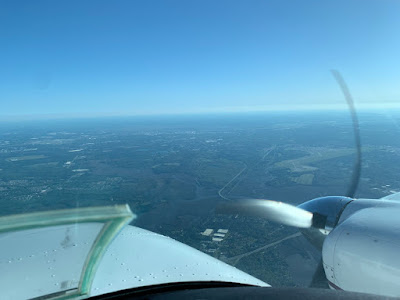
Most people are are familiar with weather radar, stay away from the bright colors.  This is good advice but eventually you will need to fly in or near rain.  The trick is to avoid the severe weather and we have a variety of tools to accomplish this.  As you can see from the above picture, when I left today, it did not look like rain.


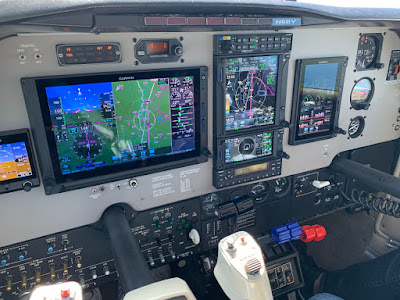
I have 3 sources of radar.  The first is broadcast via satellite using the XM radio system.  The second is sent via ground based transmitters and the final is an onboard doppler radar.  Interpreting all these pictures can be tricky.  The same image viewed on the panel screen has a different color coding when on the iPad.   I flew a good bit under the green area today and was not in any rain and the ride was smooth.  The picture is not wrong, it was just painting moisture at a different altitude than I was flying.


The two radars that are transmitted to the plane have the advantage that the picture is generated by the governments massive and powerful radars.  They also cover the entire country so I can see far, far away.  Also because the radars are a composite of many different antennas and their power, the chance that one storm can block the view of a storm behind its eliminated and you see a good picture of the actual precipitation.


It is not perfect though.  The ground based transmission you can't get while still on the ground so for the first few minutes you have no data from this source.  The bigger problem is that you are not looking at where the rain is, you are looking at where it was.  The picture is 5-15 minutes old by the time it gets to your screen.  Big picture this is fine but a fast moving storm could have moved 15 miles while you were waiting for the picture.  Also quickly developing storms can become severe before they evr show up on your screen.  That's why datalink weather is only good from strategic planning.


Airborne radar should solve all these problems except Physics.  The radars on the ground are huge, 28 feet across.  The dish in the airplanes nose is only 1 foot.  The NOAA radars have about 800 time the area and loads more power.  When you send out a radar pulse, the energy bounces off the rain and returns to be measured.  The more rain in the way, the more the energy is needed to see farther.  I have 40 Watts of power while the ground based units have 450,000 Watts.  Yes size matter.


Size matters not only for power but also beam width.  The radar is like a flashlight.  The further out it goes the wider the beam.  At 10 miles the core of my beam is 8000' wide.  That means it is 4000' above and below me.  At the full range of the radar (320 miles) the beam is 25 miles tall and wide.  In the picture above at 120 miles the beam is 18 miles wide.  What this means is that the farther out you go, your resolution suffers proportionally.


Sorry flat earthers, one more problem.  The earth is round.  Up close this does not matter much but at 100 miles, if you send your beam straight out, it is actually 7000 higher above ground because the ground has curved away from you.  Rain is basically visible from the freezing level down, ice does not reflect as well.  We compensate for all these issues by tilting the dish up or down to point the energy where we want it.  


One last problem, the ground is a great reflector so even on a clear day, the radar will paint what looks like storms but it will just be the ground.  Cities with their building look like bigger storms.  With all the problems, why bother?  Well if you practice a lot, you can learn how to direct that beam and understand what it is telling you.  The combination of old but very precise information with real time scanning of what you will fly through in the next few minutes is a powerful tool to avoid serious weather.


Having all those big screens means I can display the different sources how and where I like.  Above you can see the sky has gone from sunny to a dark wall.  Below I am watching datalink on the left and real time on the right,.  I am tilted up 4.5 degrees which eliminates most of the ground but the beam is above the farther rain and thus I am not painting any rain even though it is there.


One really cool feature is to overlay the live radar scan on the moving map.  While that looks really ugly, what you are actually seeing is the ground return, I had not yet adjusted the tilt.  Of course all this can get confusing.  If you display the radar on 2 screens it splits the back and forth scan and each screen gets one direction.  This way you can have 2 different settings at the same time.


After exploring the multitude of radar information, I turned around and made a quick gas stop.  Then it was back home before the storms arrived.


Saturday, April 3, 2021

Solo


Today was the first time I flew the Baron solo.  It was not my first solo but it was my first multi engine solo.  The routine was not much different than my instruction flights.  I started with a detailed preflight.  It was cool again today and I knew I would want the heater.  It had quit on the last leg yesterday.  I had a good idea why it quit and my pre flight confirmed it.

The heater is in the nose wheel well and if it gets too hot, it pops a safety and shuts off.  You need to press to reset but that's not possible while flying.  During preflight I pressed the magic red reset button and then heater operated correctly for my entire mission today.  I learned my lesson that it is important to have sufficient flow before pulling the heat control to full hot.

We brief the departure in a twin every time.  Some numbers never change, Vr is 85 and Vyse is 100.  The weight changes and expected performance changes so these are good to know so you can determine if things are happening as expected.  The other important brief is "the drill".  The drill is what you need to do if you lose an engine on departure.  It is pretty straightforward, you are checking the configuration and engine controls and if that does not bring the power back, you are feathering the bad or what we call the "dead" engine.

I have done "the drill" a lot lately so why do it before each departure?  The theory is that in an emergency you will sink to the level of your most recent training.  Practicing the process and the muscle memory over and over hopefully means that when you have a bad day, you will revert to what you have practiced again and again and execute it correctly.


Today, it was just for practice and everything worked as intended.  I spent the beginning of my solo time practicing steep turns and working out power settings I will typically use for economy cruising and sightseeing.  It is useful to have some go to settings where you know the engines will be happy and you you know the performance to expect.

After enjoying some sightseeing and just some relaxing flying, I contacted approach and got flight following up to Baxely, GA.  This is really just more training, short cross country flights to different airports to practice with the new to me radios.  I am finding it is really nice to have access to everything on the PFD.  Above I am briefing the arrival frequencies. Basically you can pull up everything about the airport from the charts to the weather without ever turning your head.


After a quick stop in Georgia, I was back in the air and headed for home.  The smooth air had turned choppy.  What I would call consistent light turbulence.  I crossed directly over JAX and then was handed off to tower and joined a left base for 5.  The winds had picked up but we had practiced all this.  I got my second very satisfying touchdown of the day.  A quick taxi back and the plane was back in the hangar.  I still need a few more hours before I can carry passengers but think I will enjoy this phase of training.

Friday, April 2, 2021

Ready to Solo


My first solo was back in 1985.  With my first aircraft, the insurance company wanted me to get 3 hours instruction before flying solo or with passengers.  My last plane they required zero time.  Moving to the twin was very different.  15 hours dual and then another 10 solo before carrying passengers.


Today I completed the 15 hours plus a little.  We decided to complete some more cross country training to practice the type of flying I will be doing with the plane.  It was cold this morning which also let me learn about the heater.  In a single you just use the engine heat ducted to the cabin to stay warm.  In the twin, there is a separate heater in the nose.  It takes a bit of talent to get all the knobs in the correct position to not be hot or cold.  Eventually I figured it out.

We departed into a stiff headwind.  At 5500 feet we had 25 knots on the nose.  This is why we flew at 5500 as the winds were mid 30s up higher.  Our first stop was KEOE, Newberry SC.  It was a strategic stop.  Fuel was well priced and it was positioned such that we would land with 2.5 hours of fuel remaining.  I am still being conservative with fuel reserves as we confirm that the fuel computer and gauges are accurate.

The only complaints with the stop were the wind and temperature.  South Carolina was much colder, near freezing.  I made quick work of the refill, though it took a bit of teamwork.  The fuel hose has a spring return and it would not stop in a locked position.  My instructor had to hold it while I fueled to keep it from retracting.

Topped off we loaded up and were soon on our way.  We checked in with Greer approach on 119.4.  Decades ago I used to fly quite a bit around Greenville and the frequency has not changed in all that time.  Our next destination was Oconee County Airport.  This is right by Clemson University.  It was also a trip down memory lane.


The last time I remember being there was in the mid 90s, I was giving Young Eagle flights in my Mooney.  Today it was pretty quiet but luckily a bit warmer and less windy than Newberry.  After a short break we were ready to enjoy the tailwind home.


We had planned a direct route but ended up with two detours.  On departure we quickly climbed to 9,500 feet and set power for 184 knots True Airspeed.  We had 30+ knots on the tail so we enjoyed better than 200 knots for most of the flight.


Part of the reason I wanted to do these cross country legs was to work on  my flows and how I will use all the tools at my disposal.  There is so much information available, you really need to think through how you will set everything so that you can easily absorb everything without getting distracted.


Back to the detours.  We were going to pass through a Military Operations Area (MOA) but it was in use.  You can still fly through but it is at your own peril.  We chose to divert around.  The iPad comes in handy as I marked some points along the edge and then sent the new plan to the panel.

This solved the immediate problem but the detour altered our later path and we would now go through some restricted airspace.  This time I used the on screen graphical flight plan edit function and altered our path around R-3007.  These were all good things as the purpose of the trip was to encounter and practice real world situations.


Heading down from altitude we were trueing out at 194 knots and making 228 ground speed thanks to 38 knots at altitude.  The arrival home was a bit choppy below 5500 but we were soon turning final.  Winds were blustery with gusts up to 30 knots. I flew the calculated numbers and kept a few knots extra to account for the gusts.  


The arrival was smooth and we were soon shutting down.  After the logbook was signed I was ready to solo but that will happen another day.

Monday, March 29, 2021

Practicing for a bad day


More training today.  Focus today was on instrument work and one engine inoperative.  A twin is great and you have options when an engine quits that you don't have in a single but...  You need to do stuff correctly and that means practicing.  When an engine quits you have an imbalance of power so you need to use rudder and bank to keep the plane going straight.  You also need to keep sufficient speed so that your controls are effective.  

Shooting an approach on one is actually not that much harder than normal.  In a gentle descent, there is not much asymmetric thrust so staying straight is easy.  Going around is harder because you have the gear down and you need to transition from a descent to a climb.  Shooting the approach at 130 makes this all much easier.

The single engine go around starts with adding power.  A smooth slow application is preferred as this allows you to add rudder and keep everything smooth.  Next step is getting the gear up.  Having 130 knots means you can level off while you do all this and still have 120+ knots left when cleaned up.  Only at this point do you begin to gently pitch for a climb.  Today with the cool air, I was able to climb 300+ fpm at 120.  If I was heavy and it was hot, I would have climbed right at 100, the best rate speed.


After plenty of instrument work and some holding practice, we flew around and practiced the electronics.  The Garmin equipment makes it easy to split screens and project a lot of information.  You can also put different sources on different screens to compare them.  For example I can watch the onboard radar on one screen while looking at the ground based picture on the other.

I am just learning how to interpret the onboard radar.  Using it is a lesson in physics and geometry.  While it has a range of up to 320 miles, the practical distance is closer to 40-60 miles. Beyond this the radar beam gets exceedingly wide so the resolution drops.  Also pointing it becomes a challenge.  Point it straight ahead and a lot of your beam bounces off the ground and back at you.  Tilt it up to avoid the ground and then the center of the beam is miles above your path and points at a part of storms that don't reflect well. 

Finally, the big problem. Don't tell anyone but the earth is not flat.  Flying at 3000 feet, at 120 miles the center of your beam is around 16,000 feet if you point it straight ahead.  If you tilt up 2 degrees to avoid some of the ground returns, your beam center is at 20,000 feet 60 miles out.

There was a small shower North of Tampa this morning and down low at 3000 we could not detect it, nor was I surprised.  All this is fine, at cruise we can see 60 miles without issue which is 20 minutes away, plenty of time to maneuver.  I'll be looking for some days with nearby storms to practice my radar skills as I continue to learn. 


Sunday, March 28, 2021

Lessons 3 and 4


Thursday I took the morning to train some more.  First up was flight maneuvers.  360 turns to begin and then steep 360 turns.  I always enjoy steep turns.  In a single engine plane the cowling is an excellent reference point for the horizon.  In the twin, the nose is actually longer but slope down more so you have to project the horizon above the glare shield.  It's not hard but takes some practice.

After some more maneuvers, we headed back to Palatka for a simulated single engine approach.  After landing we taxied back and did a few more  landings and then stopped to fill the tanks.  On the way back home, we did some additional simulated engine out including climbs, turns and just plain flying.

In the first 3 lessons we focused on the discrete aspects of safely operating the plane but long time readers will recognize that these flights are nothing like a typical mission for me.  Today we tied it all together and took a short trip.  We flew to Walterboro, SC and then on to Jesup, GA to refuel and then home.

Why these places?  Well it allowed for 3 hops which approximate the type of trips I take.  It allowed me to program and manage the electronics, manage the engines from start, to departure, to climb, to descent and finally landing. The locations picked were based upon the weather.  I wanted to avoid anything bad and with a big front coming, that pretty much set our direction.

Overall the trip went well.  I did get distracted at one point while getting the autopilot modes wrong.  I descended off intended altitude and heading while playing with all the new toys.  My instructor let me get far enough off my intended path before mentioning it to make the point.  Hopefully lesson learned.  I still need to work on my flows and scans.  

The amount of information displayed is more than I had previously had but several key pieces of information are now in very different places.  This causes 2 problems, first I am wasting time and brain power getting to things.  This just means I need more practice behind the panel.  

For example loading a new frequency.  I am used to just twisting it in and hitting the flip flop button.  With the new radios, you can type it, which theoretically is faster and then select it active.  This only works if you hit the right sequence.

The second issue is that I am used to certain behaviors.  For example my old panel had a very distinct "Altitude" call whenever I started to deviate from my set altitude.  This one does not.  Basically this means I just need to practice more.  


Tuesday, March 23, 2021

Here comes the sun


It has been quite a few days since I trained.  Had a good first session and then the monsoon came.  Either the rain was coming down or the clouds were really low.  While I would normally be all over some of this weather for instrument practice, with a new plane I  needed good weather to work through my next training objectives.  

I finally got some sunny skies this morning.  First objective was some Airwork.  Last flight we were loaded pretty much at the front of the envelope.  I moved some stuff around and we had less fuel today so while we were still at the front of the envelope, we were not as close to the edge.

I noticed the difference on departure.  The plane behaved a bit better on the ground with less weight on the nose wheel.  After wheels up we headed to 7500 feet and cleared the area.  Once clear I practiced some slow flight both clean and dirty.  The next exercise was stalls.  Barons have a reputation for dropping a wing in a stall.  

First stall was clean and I was ready on the rudders to pick up a wing.  I was pleasantly surprised though, as the plane slowed I could feel the imminent stall approaching and had a solid buffet before breaking straight ahead and a conventional recovery.  At our weight the book says the plane stalls at 83 KIAS.  It stalled at 75 which confirmed that the VGs were doing their thing.  VGs or vortex generators are small tabs across the front of the wing span that  help energize the boundary layer and delay the onset of the stall.  They claim to get you 9 knots reduction and we saw at least 8.

Dirty stalls (with flaps) were next and the break came at 65 KIAS while the book claimed 72.  The VGs are supposed to give you 5 knots so this was better than expected.  The dirty break was also straight ahead.  So much for bad mannered Barons.  After a few of each type of stalls, we moved onto simulated single engine flight.

The manual has a power setting which simulates one engine feathered.  The instructor set that power and I added power on the good engine.  At 7500 feet and 5250 pounds, the plane climbed 200-300 fpm on one.  It was relatively easy to manage the yaw with rudder and a slight bank into the good engine.  The ideal profile is 2-3 degrees of bank and a half ball deflection towards the good engine.

After single engine practice we slowly warmed the idling engine and then began a descent towards St. Augustine.  I called approach and requested some practice approaches.  We shot 3 GPS approaches, one with a hold in lieu of a procedure turn.  The final run was an ILS and then we broke off to the North to fly the GPS 32 back home with a circle to 5.

Lining up on final, everything was looking good and passing 50 feet I was on speed.  Having a slightly more rearward loading made a difference.  The flare went nicely and I was able to hold the nose off after touchdown.  This really helped slow the plane quicker and I think in a more typical loading I will typically fly. This should make arrivals and departures a bit easier but it was good to train at the more difficult part of the envelope.


Sunday, March 14, 2021

Training begins


Training officially began today.  That is not completely accurate.  I am already a trained multi engine pilot.  This is really type specific training but the training really started months ago.  Before I purchased the plane I studied its performance and systems and compared it to several other types.  After I had decided on the Baron I continued to study both the aircraft specific material and did a complete refresher of multi engine flying.

Months later I was almost ready to fly.  I say almost because the day began with discussing the day.  We briefed the objectives, our plan and how we would manage any abnormal situations.  Since I am transitioning, the plan today was for the instructor to assume control if anything bad happened near the ground.

It was finally time to actually fly.  The plane's engines are a variant of the engine in the Bonanza.  It has 550Cs vs. the 550B.  There are differences but only things a mechanic needs to worry about.  From the pilots perspective, you operate them the same.  This made the start up and engine management much easier.

Taxiing out you feel the extra weight.  We were right at 4900 pounds, we would later top off bringing us to 5380 pounds.  This is about 80% more than the Bonanza.  The pre departure checks are almost the same except you have 2 engines to check and we need to check that the props will respond to the feather command.  Finally we reviewed the departure brief and then called tower ready to go.

First takeoffs are always more stressful and as I lined up, I reviewed the brief one more time as I prepared to go.  After that, power up, check the engine gauges to confirm good reading,  85 knots is Vmc and rotation, a bit of back pressure and we were flying.  Lots of power and a few seconds later, I had good rate and was approaching Vyse which is best rate on one engine.  Gear came up and off we went.

I got the feel of the plane on the way to Palatka.  My first pattern was wide to give me extra time and it was all looking good until at 100 feet the instructor commanded a go around.  I complied not knowing if there was a real issue or if it was for training.  It was for training and we made another run at it.

The first touchdown is always extra exciting.  I had sat in the plane and noted the sight picture but it is different to achieve that while managing the approach and all.  Speeds were good on final and I was rewarded with a smooth touchdown.

We did a total of 7 landings today.  Each time to a full stop.  The loading with full fuel and 2 guys is very near the forward limit and I can really feel that in the flare that the nose is heavy.  While I am not ready for short runways, I did one short field landing and had the plane stopped in 1400 feet.  It likes to roll so this required using the brakes more than I like.  

By the time we headed home, I was very comfortable with just 4000 feet and a gentle crosswind.  This was a good start.  Next up is air work and single engine procedures.

Saturday, March 13, 2021

Times are a changing


Well February was a quiet month flying wise.  In January we closed on the new plane and then I had to wait for the mechanic to get to it to clean up a few issues we found on the pre-purchase inspection.  Then I went and flew it and found 2 small items and had to wait again.


Covid has devastated some businesses but others have had the opposite problem.  Back last year I was down an extra 2 weeks because the prop shop was way behind so I was not too surprised I had to wait.  I had planned to list the Bonanza when I brought the Baron home but a funny thing happened on the way to the forum...  Well the mechanic actually.


While we were getting into the Baron to fly it, a person was looking at the planes parked at the mechanic.  I said hello to him and in the ensuing conversation mentioned it was going to be for sale.  He already had a Bonanza but his friend was looking for one just like mine.


By the time we came back, the friend had reached out to me and he has an offer pending on the plane.  So far it has been visually inspected and test flown.  In the picture below she is heading off for a mechanical inspection and if all goes well, He will fly her back to the West Coast.  Somewhat ironic as I picked the plane up on the other coast and brought it here.


A little sad the plane is on its way to market but excited because the Baron is home.  This is probably for the best as the planes would have become jealous of each other.

Sunday, January 31, 2021

Good Neighbors, Clear Skies, Storms and Wind


Yes, I have the Baron but it is not home yet and I am not trained.  I am still flying the Bonanza.  Yesterday I took a nice flight with CC and this morning I decided to head out solo.  Well it was getting windy when I left and the forecast was for windier.  It was accurate.   It was also bumpy below 2500 and really bumpy below 1500.  I flew around a bit and decided with the strong surface winds to get gas at Palatka because Saint Augustine was a significant crosswind.


Arriving in the area, there was a Cirrus a few miles ahead.  As he cleared the runway, he said he was heading for the self serve fuel.  That was my destination as well.  I asked him if he could pull forward enough so that I could position for fuel after him.  He said he would.  Palatka has only a single pump and many people pull in short of the pump so if another plane arrives after and shuts down they are too far away to fuel without restarting or pushing themselves closer.

The Cirrus did a great job and he left me plenty of room to pull up so that when it was my turn the hose would reach.  After some fuel pump chatter, topping the tanks and checking the fuel, it was time to head home.

The headwinds were actually tailwinds now and I scooted along at 170+ knots ground speed back to Jacksonville.   The sky was blue and cloudless above but off to the North and West, you could see the outline of the approaching front and the rain in Georgia.  

Arriving home the tower put me on downwind for 23.  I asked for a tight approach but tower wanted me to follow a Cirrus on a 5 mile straight in approach.  I was not sure why, he was going 120 ground speed which meant he was 2.5 minutes from the runway.  I would be off the runway in 1.5.  The tower has final say, so I extended and the Cirrus promptly slowed down to 70.

I joined behind the slow moving traffic and held a good sequence but when the Cirrus landed he somehow did not make the middle turn off and then took his time getting off the runway.  I slowed a bit to build space  and when I got to 500 a hawk decided to circle right over the end of the runway.  I had been watching him and either he didn't see me or didn't care.

Not wanting to meet the hawk, I decided to go around.  I did and the tower put me behind a Skyhawk.  Again I was amazed the little Cessna, could not stop by the mid turn off and went to nearly the end of the runway.  The wind was 25-30 knots on the nose and I landed in just a few hundred feet and had to add power to get to the close turn off.  It all ended well with the plane full and safely in the hangar though. 

Monday, January 25, 2021

A new addition

The blog has been a bit quiet the last few weeks.  I have to admit I have been a bit unfaithful.  While I was still flying my Bonanza, I had my eye on a pretty Baron.  Today we planned to fly down to New Smyrna to close on the Baron but the weather was quite foggy.  We drove instead, it was a good decision.

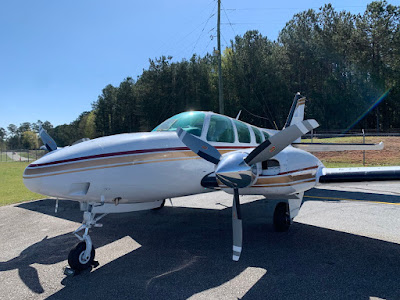
Our new addition is a 1991 Baron 58.  The Baron has two 300 HP engines compared to one on the Bonanza.  Its faster but only by about 15-25 knots.  It does have significantly more redundancy and room.  During the purchase process we identified a few areas that need to be fixed so the plane stays at the mechanic for a bit.  


After this it will be Baron school for me.  I am rated for this aircraft but have never flown this exact model.  The insurance company requires some hours before I can head out on my own.  This was not a big deal as I had planned a more extensive program before I got the requirements. 


I started the blog to document our travels across the country and since the Baron is also a Beechcraft, the name still makes sense.  I may not land the Bonanza in each state but the Baron will hopefully let me complete the quest.

A lot more to come in a few weeks once I start training.


Monday, January 4, 2021

A cut above

Sunday started with some marginal weather which actually made me feel a bit better about having a work meeting at noon.  Once done with my call though, I looked out and the sky had begun to turn blue.


I decided it was time for the proverbial Sunday ride in the country.  We have been watching that ship in the Brunswick sound for quite a while and I saw on the news they had actually made a cut and removed a piece.  We headed up to Saint Simons to see for ourselves. 


While they had removed a piece and actually made another cut, most of the ship was still there. You can see in this picture the cut and how the section has been moved away from the main section and lifted slightly.


It was actually a pretty busy day up at SSI with a good bit of local traffic.  Luckily they were all arrivals when we showed up and they were using runway 22 which kept us well separated.  We also stayed up at 1500' to provide some extra margin.  On our second circle a Baron was departing but we modified our turns to stay well away and provide him plenty of room for his departure and turn North.


The excitement is now at the stern which left a nice view of the bow cut.  You can clearly see the cars still scattered between the decks.


After 2 times around, we headed South and enjoyed the views on our ride home.  Taking apart the ship is taking longer than originally planned but it does appear that they will be able to slice it up like they said.


There were a slew of small boats that looked like they were trying to manage the debris.  Hopefully they can complete the job without making an ecological disaster.


Sunday, January 3, 2021

Train, Train, Train

I like to fly on holidays.  January 1, 2021 is a new year and a new chance to fly.  My hours were down in 2020 about 20%.  This was mostly due to cancelled trips.  I have been doing a good job training though and I wanted to keep that going.  With great weather I decided to start the New Year off with some more practice.


It pays to keep sharp.  On December 31st I had taken a quick run South with CC to visit another airport.  The winds were gusty and a direct cross wind.  Combine that with trees by the runway edge, low level wind shear and turbulence and you are one busy pilot landing.  This is why we train a lot.  Though challenging, it was well within the plane's capability and other than a really bumpy ride from 300 feet to 20 feet which we anticipated, everything was quite nice and I was even rewarded with a smooth touchdown.


Given that this was a holiday I decided to practice the things I really enjoy.  After clearing the area, I started with some steep turns.  Those went well.  You know because you hit your wake as you complete a 360.  It is pretty cool, because you can't see the turbulence you create but if you do a good circle and stay on altitude, you come back around and get a satisfying bump as you roll wings level.


After steep turns I did Chandelles.  This is a maneuver required on the commercial check ride.  You roll into a 30 degree bank and then smoothly increase pitch while turning 90 degrees.  In my plane this leaves you at 15 degrees nose up.  You then hold that pitch while smoothly rolling out of the bank.  If done correctly you complete 180 degrees of turn just as the plane reaches a speed to activate the stall warning.  Doing them left and right is quite different because the engine torque requires right rudder  so combining this with the different direction banks changes things up a bit.


My final maneuvers were slow flight variations.  I practiced flying just above stall and then worked on turns just above stall at increasing bank angles.  I worked up to 45 degree bank turns with partial flaps with the stall warning chirping as I made 180 degree course changes.  It was a glorious day and it was good to work on my basic airmanship.  When flying with passengers you try to limit the pitch and bank to optimize the experience in a good way.  Training has you practice a much wider range of the flight envelope.  In both cases, a smooth fluid flight is ideal.